|
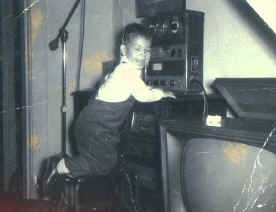
WDFH-FM is the result of an effort spanning more than 20 years. Marc Sophos started the station in 1968, when he was ten. From then until 1982, it could be heard only around the block as an ultra-low-power (FCC Part 15) station. In 1982, Marc persuaded the local cable company to carry WDFH's signal as background audio for some of the system's data (bulletin board) channels, and the station continued to operate on cable until December, 1993, ultimately reaching about 14,000 cable subscriber homes. However, his goal was always to establish WDFH as a legitimate FM station.
The early days . . . Marc's effort to
achieve this goal started in early 1973 when, as a ninth grade student at
He assembled a group of friends to assist him and enlisted the enthusiastic support of no fewer than four faculty advisors, including the high school’s principal. After more than a year of research, meetings, and presentations, the Dobbs Ferry Board of Education granted the group's request and allocated money for the station — no small feat, considering that the school budget was rejected by voters that year and the district had to go on an austerity budget, cutting funding for all extracurricular activities. But the School Board was so strongly convinced of the proposed station’s great value to the school system and the community that it re-allocated the station to the science budget, ensuring that it wouldn’t be cut. The exhilaration over the School Board’s
approval didn’t last very long.
The radio station group hired a communications consulting engineer
to conduct a frequency search shortly after the money for the station was
allocated, and the resulting report revealed that because of Dobbs Ferry's
proximity to New York City, with its crowded radio dial, no AM or FM
frequency was available. (Dobbs Ferry is just 18 miles north of the
Moving toward FM During the following years, while home from
college breaks (he was studying Telecommunication at
The elusive FM dream remained, however.
During his years at
Success? His persistence eventually paid off: in 1984,
Marc located a consulting engineer in
That cloud on the horizon starts to blot
out the sun . . . Once again, the celebratory mood was to be
short lived. WDFH unexpectedly and abruptly lost its lease at the
original
We worked feverishly to get the station back on the air. Under the new federal Telecommunication Act of 1996, the license of a station that goes off the air for a year, for whatever reason, is automatically canceled, with no possibility of appeal — another aspect of that wonderful law. In our case, there would have been no way to re-apply, so we were looking at a total loss. However, we were able to secure a new tower site in June 1997 and immediately started work to secure the necessary zoning and FCC approvals, which came in the fall. In the end, we came within three days of that crucial deadline, but we returned to the air with limited programming in late October 1997, with major support from AT&T Corporation, the owner of the tower site. WDFH's signal had been limited from the original Ossining site, but this forced relocation made things even worse. We believe that only about 10,000 people were within reach of the signal from this new site. (The FCC's estimate was higher, but it was based on technical assumptions that didn't apply in our case.)
New studios and an ill-fated alliance with
With the license now
preserved, our attention turned to re-establishing new studios.
In the spring of 1998 we approached
This long-awaited alliance was finally formed when the contract between the college and WDFH was signed in December 2000. We started
broadcasting from the
new studios on
To address our longstanding signal limitations, we started in September 2001 to work on an expansion. This project was, in typical WDFH fashion, a roller coaster. Then: In 2004, the college abruptly discovered that it was facing very serious financial problems and, in the face of steeply declining enrollment, began cutting programs and laying off faculty and staff. In 2006, the alliance between WDFH and Mercy ended. We again had to vacate our studio space and put all of our equipment in storage, completely breaking the momentum once again and initiating another lengthy transitionary phase. Local program production came to a complete stop, and we stayed on the air with pre-recorded programming, in addition to Democracy Now!, Free Speech Radio News, and other programs from Pacifica and other independent producers, which we were able to continue airing. But in 2008, with some creative engineering and a targeted grant, we were able to resume production of In Focus and Recovery Talk, two signature local public affairs programs. 2009: The long-awaited signal expansion is completed! Our years-long signal expansion project picked up speed in 2007. We secured zoning approval and completed mechanical engineering and design in the summer and fall of 2007. We filed a new FCC application in August 2007 and the FCC granted it four months later. In February 2009, the project was completed, and WDFH's new signal can reach about 400,000 residents of the lower Hudson valley.
2009: The webcast is reinstated. Several years ago, we had to shut off our webcast because of onerous reporting and other rules. (A tip of the hat to the recording industry for fostering creativity and diversity in online programming.) But in 2009, a separate agreement was reached to cover webcasting for public radio stations, and as a result, we were able to reinstate our webcast in 2009. A tremendous amount of work was required — for example, three months of solid work to make a database of some 4500 songs — and on an ongoing basis, we must make extensive music reports every quarter, diverting many staff hours away from more important work that would serve the community. But the webcast opens WDFH up to listeners beyond our FM coverage area. There are three streams: a high speed stream for those with fast connections, a medium speed stream for iPhones and other mobile devices, and a slow stream for dial-up listeners. WDFH is listed in the Public Radio Player iPhone app. Our local public affairs programs are also available on demand and via podcast. (Copyright rules make it difficult for us to provide music programming on demand or via podcast, and given the other demands of developing WDFH, we've chosen not to go down this road for now.) Hosting of our webcast is generously donated by our local ISP, Bestweb, which has been a WDFH ally for years. And now, studios. Finally. In April 2010, we held a public meeting at the Chappaqua Public Library to introduce WDFH to people in our new coverage area. There was press coverage in connection with this meeting, including a front page article in The Journal News. As a result of this coverage, a community-minded citizen stepped forward and made it possible for us to acquire studio space. We started recruiting new volunteers in the spring of 2010 and spent the summer of 2010 building our new studio, which includes equipment and furniture donated by The New York Times (from the former WQXR studio) and NPR. Training new people started in the fall, and in November, we made our first live broadcast from the new facility. The last live broadcast on WDFH had been in July 2006, so it would be a considerable understatement to say that this development was long-awaited. In January 2011, we added other live programming and, with new volunteers joining up, launched two new local public affairs programs — Village Green, which focuses on environmental sustainability, and Eyes on Westchester, an expansion of our local news discussion program In Focus. (Program details....) So for the first time ever, WDFH now has these two critical elements — a studio and a viable signal — at the same time. A large-scale revamping of the programming took place in January. We held a grand re-opening celebration on March 12 and were joined by about 125 guests and two musical acts — Jann Klose and Starnes&Shah; both have returned for live in-studio performances and interviews since then. (See writeup and pictures at Patch.com.) More live musical performance continued into the spring and summer of 2011. OutCasting, our new program that will give voice to GLBTQ youth, will debut in October 2011. New music program hosts will be joining the air staff soon. New volunteers are joining regularly and we have expanded our funding committee from two members to eleven. So it's an extremely exciting time at WDFH, but we still have an uphill climb, especially given our tenuous financial situation. Please make your tax-deductible contribution today. If you know of people who might be in a position to make major donations, please contact us. Help spread the word by telling your friends about WDFH. Follow us on Facebook, Twitter, and YouTube. Volunteer. We have a very rare resource here in the lower Hudson valley. We've done the heavy lifting to get to this point, and now it's up to you to make the station fly!
Press coverage Much has been written about WDFH over the years. For a partial listing of articles, click here. Unfortunately, with our staff resources stretched to the breaking point, we haven't kept this list up to date, so recent articles aren't listed.
FAQ: What does "WDFH" stand for? Listeners often ask us what the call letters WDFH stand for. As mentioned above, the first thing they stood for was "Dobbs Ferry High," after the unsuccessful high school station effort that marked the beginning of Marc's 20 year quest to get a new FM license for a station to serve the northern suburbs of New York City. Later, in the late 1970s, a group of WDFH volunteers from the neighboring village of Hastings-on-Hudson, unhappy that their village wasn't represented in the call letters, appropriated the "H" for their own purposes. More recently, in the late 1980s, one of our volunteers, Patrick Collins, decided — on the air, no less — that WDFH stood for "Wild Dogs From Hell." (This occurred during one of the more infamous broadcasts of Pat's program with the inimitable Nick Sarames.) The moniker stuck, and though it's not official, it comes as close as anything else. So take your pick.
|
|||||||||||